Ashland Food Project launches campaign to keep up with demand
SNAP benefits pause and delay during shutdown adds pressure on local food aid; campaign launched to ask 2,400 ‘Green Bag’ donors for help
This article was originally published by Ashland.news on November 4, 2025.
With the recent suspension and delay of Supplemental Nutrition Assistance Program (SNAP) benefits during the federal government shutdown, a local grassroots nonprofit that wants to reverse a loss in the number donors with a campaign to help supply the demand for local food aid.
Ashland Food Project (AFP) loses about 10% of its donors each year due to various life changes, including relocating or financial struggles. To maintain their donor base and meet the growing need for food, the nonprofit has launched the Ask a Friend campaign this November.
The campaign asks each of their current 2,400 donors to reach out to someone they know to enroll, or enroll them, as an AFP food donor.
While volunteers continue to recruit at the Ashland Food Co-op and farmers markets, the campaign “enlists our current donors to be our ambassadors,” said AFP Board Vice Chair John Trivers in a phone call to Ashland.news. “They know more than anybody else — the efficacy and profound impact that their simple participation has on the output of food.”
As federal support for food assistance drops and food prices skyrocket, Ashland Community Food Bank anticipates a 100% demand increase in the new year, as previously reported by Ashland.news.
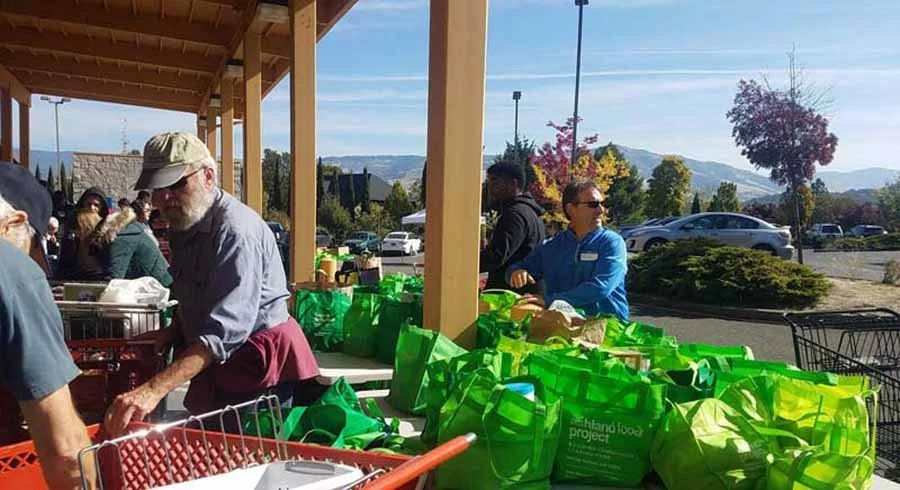
Volunteers at the Ashland Community Food Bank organize donated "Green Bags" of food on a bimonthly collection drive. John Trivers photo
Trivers continued, “The needs are growing, and we’ll be able to meet that need if we can increase the number of donors we have through our campaign.”
All donated food will be sent to the Ashland Community Food Bank. The organization has helped stock 30% of the food distributed by the food bank, Trivers said. They have collected more than 2 million pounds of food since its start in 2009.
“Everything that is done stays locally,” Trivers said.
The food bank serves people from Ashland and Talent, 90% of whom are housed. United Way’s “ALICE” category of low income — Asset Limited, Income Constrained and Employed — includes 44% of Ashland households and 54% of Talent’s.
How the ‘Green Bag’ works
After filling in a half-sheet sign-up form via the website, new donors will be contacted by a volunteer who will provide the green, grocery-sized bag and answer any questions. Once enrolled in the Green Bag program, donors fill their bag with shelf-storable food items for the next two months. They donate one bag of food six times per year.
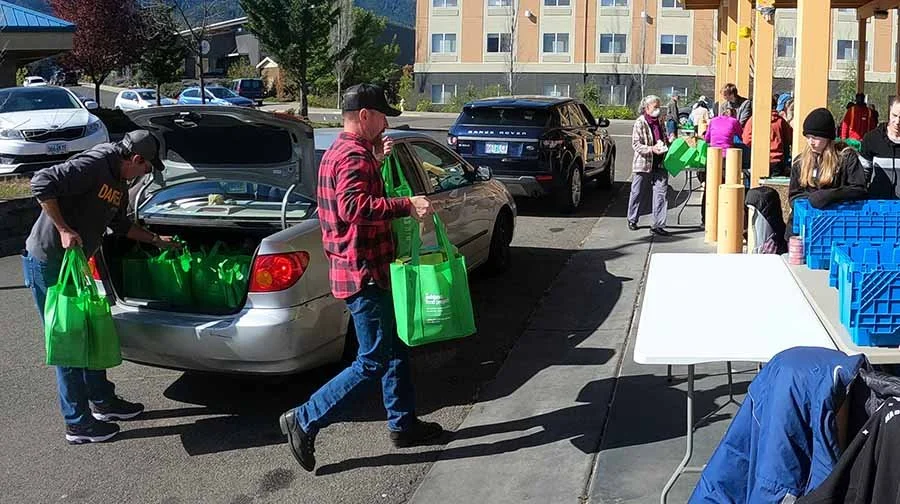
A neighborhood coordinator with the Ashland Food Project delivers a truckload of food to the Ashland Food Bank. John Trivers photo
When donors leave the bag near their front door on a bimonthly collection day, one of 140 “neighborhood coordinators” picks it up, leaves an empty bag for the next pickup and delivers the food to the food bank.
Enrolling in the program is “simple and easy,” Trivers said. “You don’t have to be asked by a donor to sign up and become a donor.” Ashland Mayor Tonya Graham, who has been a Green Bag donor for several years, encourages everyone who isn’t a member to sign up “as quickly as possible given the current withholding of SNAP funds by the federal government.”
She said to Ashland.news over the phone, “It helps those of us who have fallen on hard times and need help putting food on the table. It’s an incredibly efficient and easy way to help our neighbors.”